Work through what's on your mind.
Before therapy, while you wait, or after to keep the clarity. AI-guided CBT for the thought that won't leave you alone.
Sound familiar?
Your brain won't let it go.
You already know it wasn't that big a deal. You can't stop thinking about it anyway.
The conversation you keep replaying. The decision you keep second-guessing. The thought that arrives at 2am and stays until morning.
That's not a character flaw. That's what happens when your brain gets stuck in a loop it can't close on its own.
- “I've been replaying that conversation for three days.”
- “I know I'm overthinking this. I can't stop.”
- “My therapy appointment is weeks away and I need something now.”
- “I know what a therapist would say — I just can't get there on my own.”
- “I'm not in crisis. I just have a thought I can't put down.”
Sound like you? Try the overthinking tool →
Who this is for
Before therapy. While you wait. After, to keep the clarity.
Before therapy
Therapy is valuable. It's also expensive, hard to access, and unavailable at 1am. Noisefilter is what you do with the thoughts in the meantime — using the same structured techniques therapists teach.
Learn more →While you wait
Your appointment is booked. It's six weeks away. Your thoughts aren't waiting six weeks. Work through what's on your mind now, so you arrive with clarity instead of a backlog.
After, to keep the clarity
The session ends. The reflection doesn't have to. Keep doing the work between appointments — and when therapy is done, keep the clarity going on your own.
How a session works
Write it. Work through it. Come out the other side.
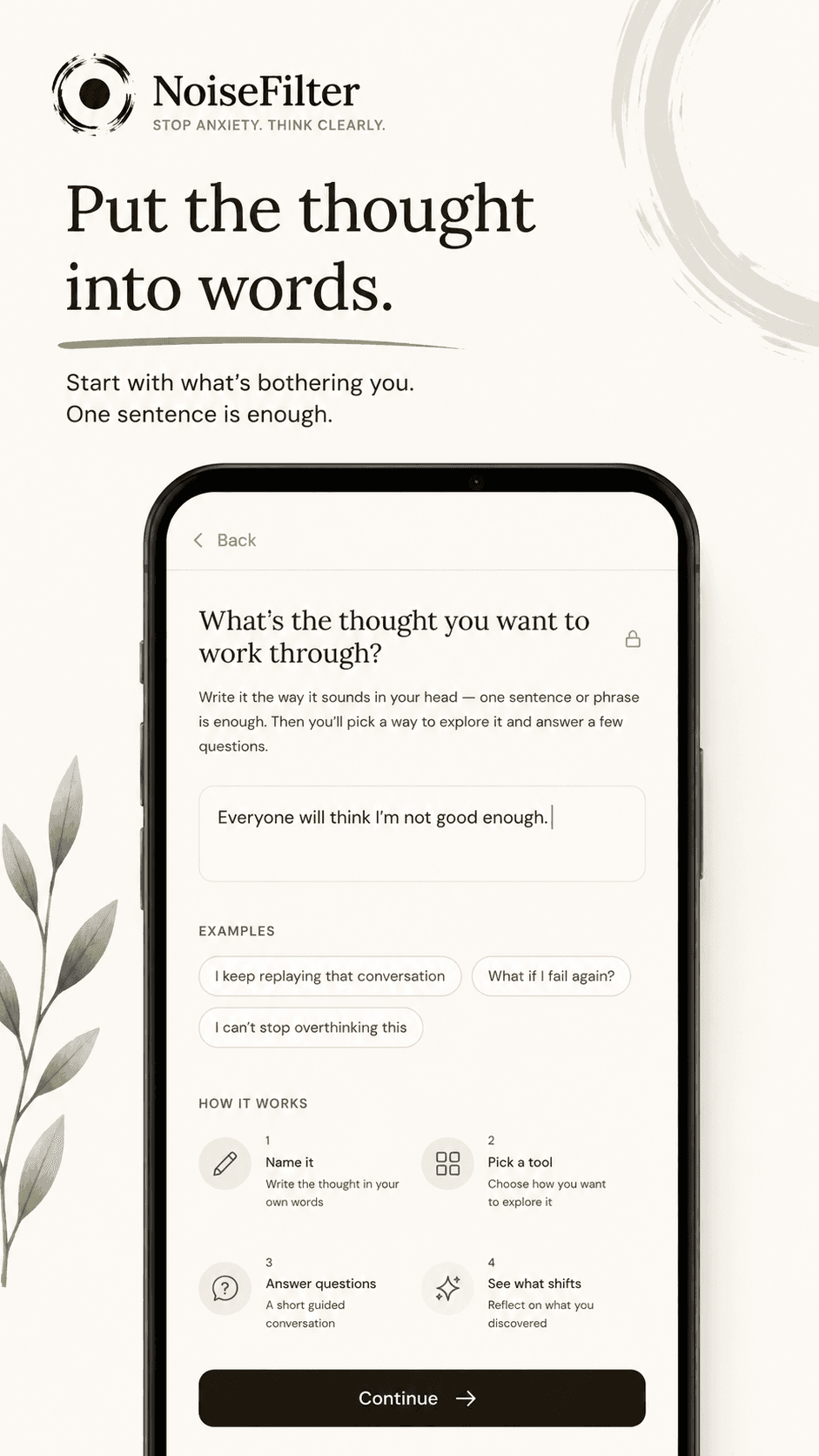
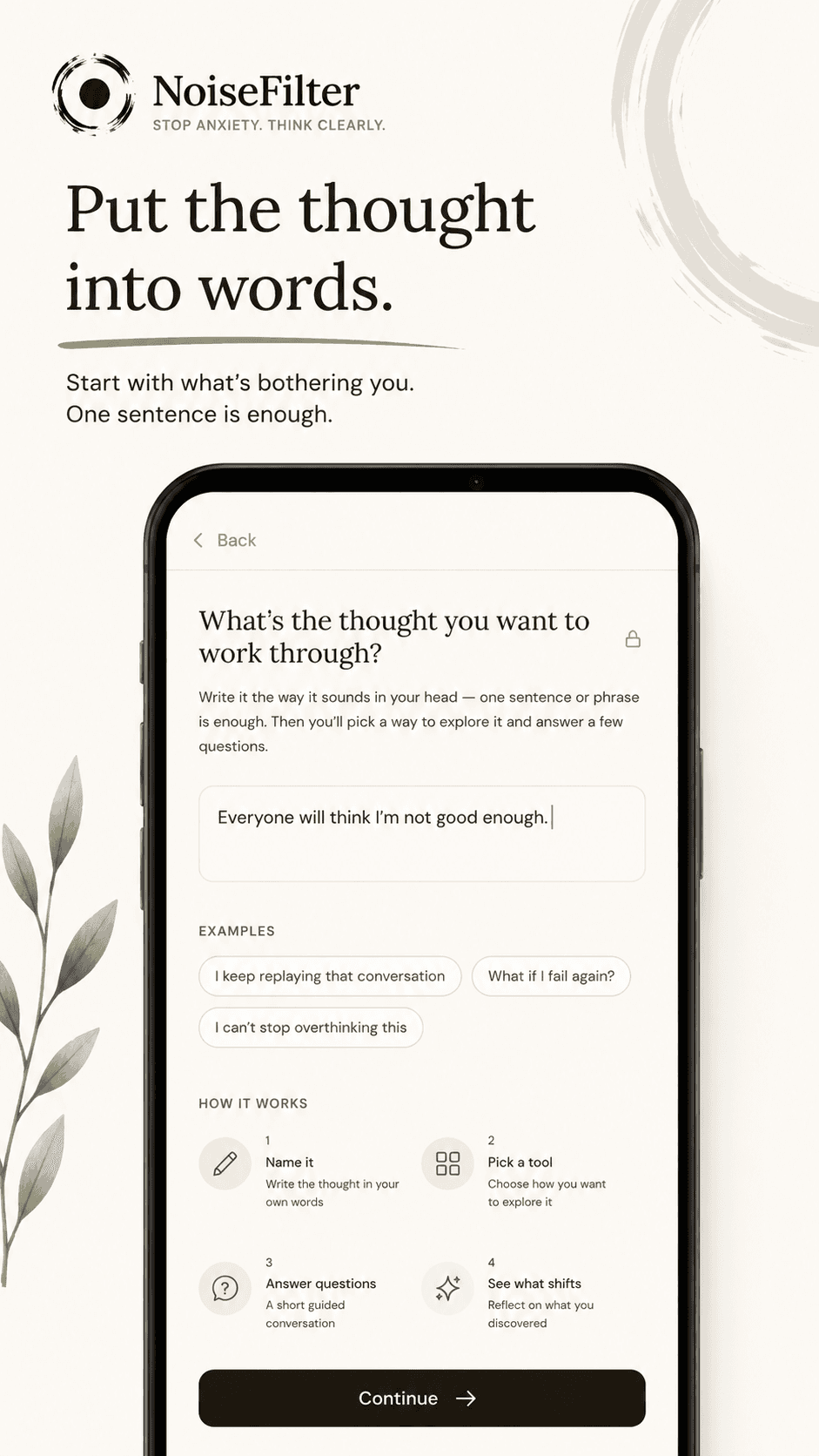
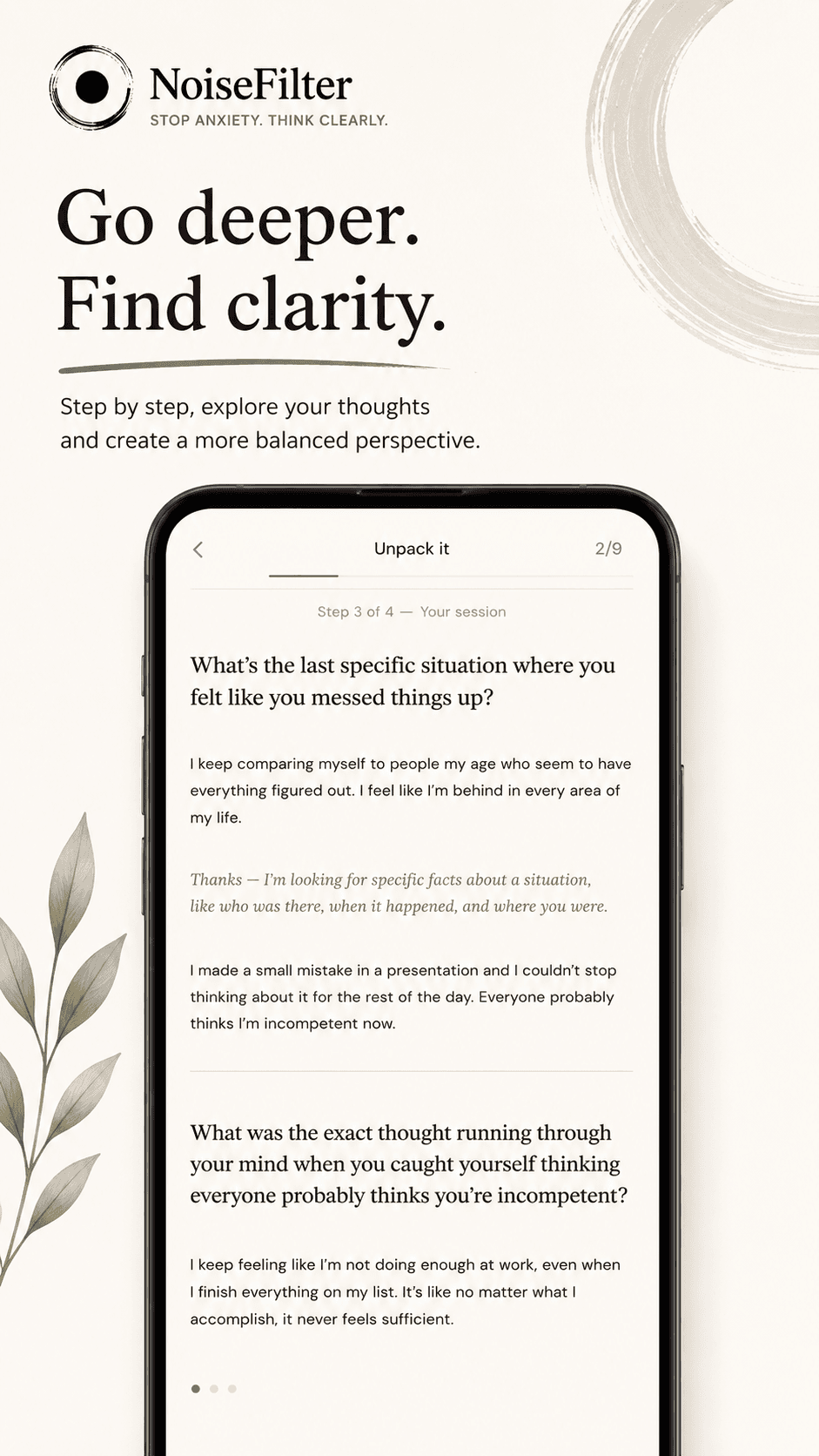
Write the thought
The one that's been sitting in your head. Raw, unfiltered, exactly as it is. No one else sees this.
Work through it
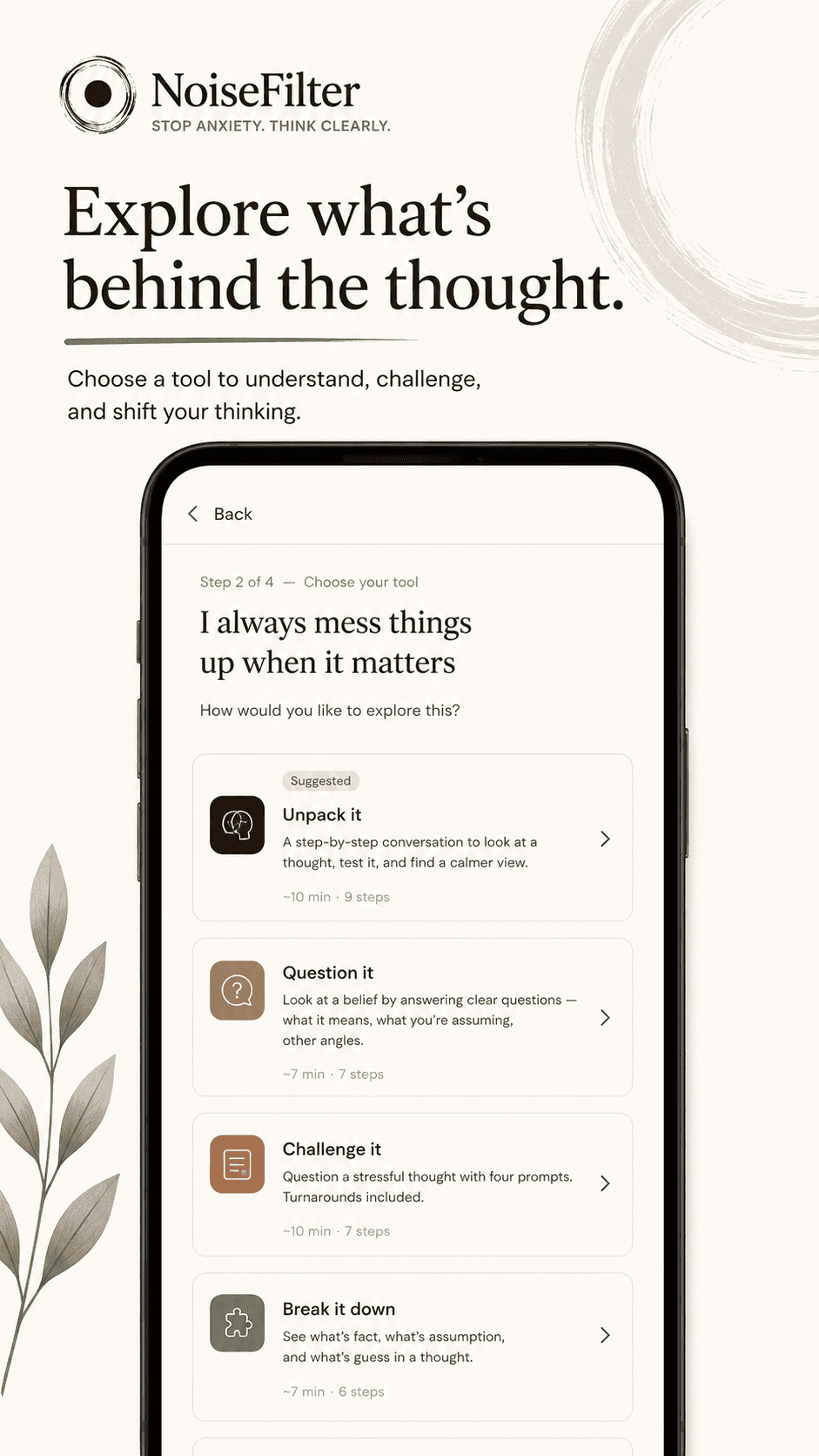
Noisefilter guides you with structured questions based on the CBT framework best suited to your thought. Not a chatbot. Not a mood log. Actual thought examination.
Find clarity
Most sessions take 10–20 minutes. You come out with a written record of what you examined, what you found, and what shifted. The thought doesn't disappear — it just stops having the same weight.
Three evidence-based frameworks
The same techniques therapists teach — in one app.
CBT Thought Record
The 7-step technique from cognitive behavioural therapy. You identify the automatic thought, examine the evidence for and against it, and write a more balanced version. Research shows 20–40% reduction in emotional intensity per completed session (Haug et al., 2012).
Best for
Catastrophizing, all-or-nothing thinking, assuming the worst
Socratic Questioning
A structured conversation that surfaces what you're actually assuming — and whether those assumptions hold up under examination. Most useful for beliefs you've never stopped to question.
Best for
Deeply held beliefs, decisions you're second-guessing, self-criticism
Byron Katie's The Work
Four questions for thoughts about the past, about other people, or about how things "should" be. Specifically designed for replaying events, resentment, and thoughts that won't resolve through logic alone.
Best for
Replaying conversations, resentment, "they should have…" thoughts
Your thoughts don't disappear here. They get resolved.
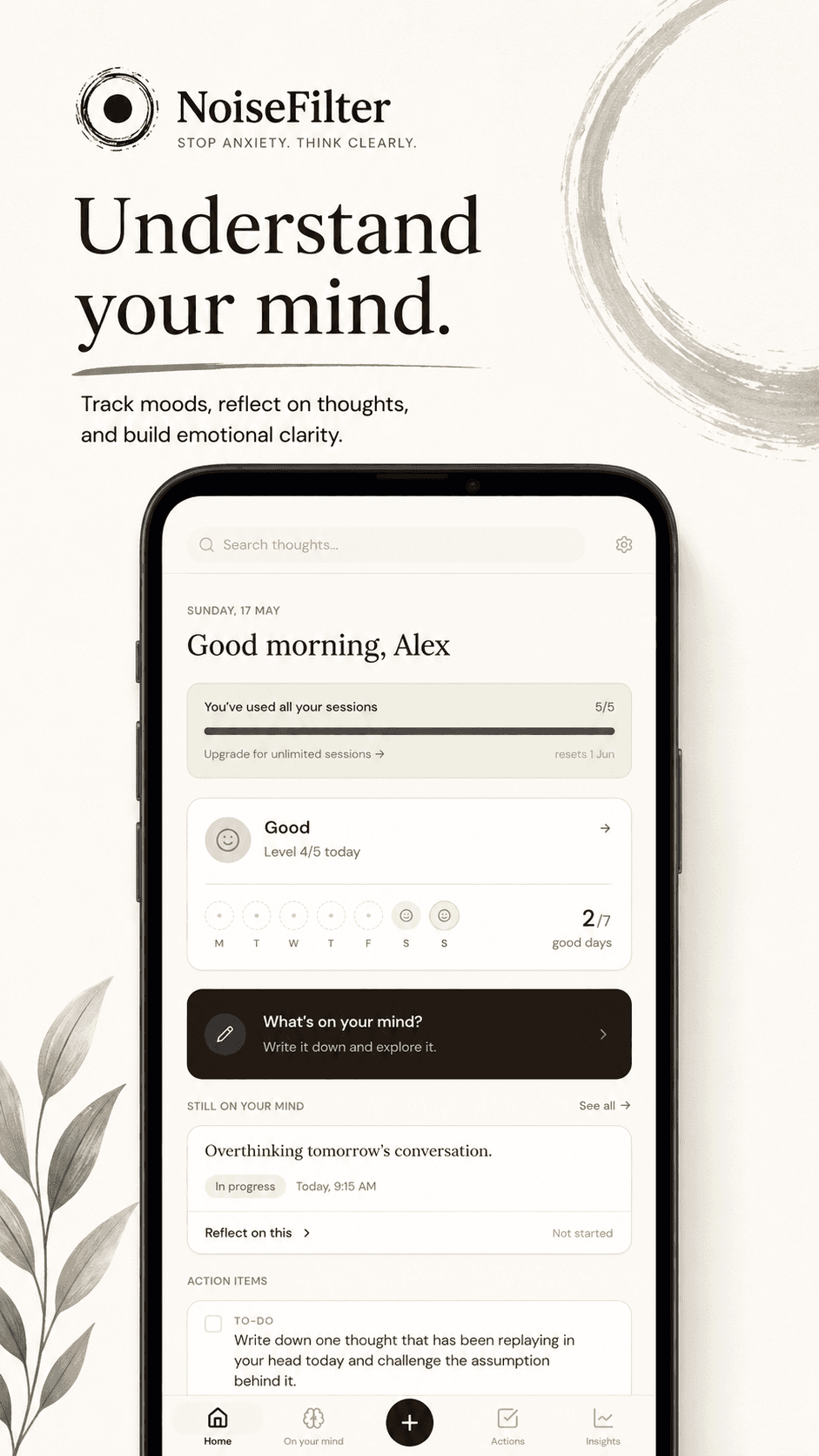
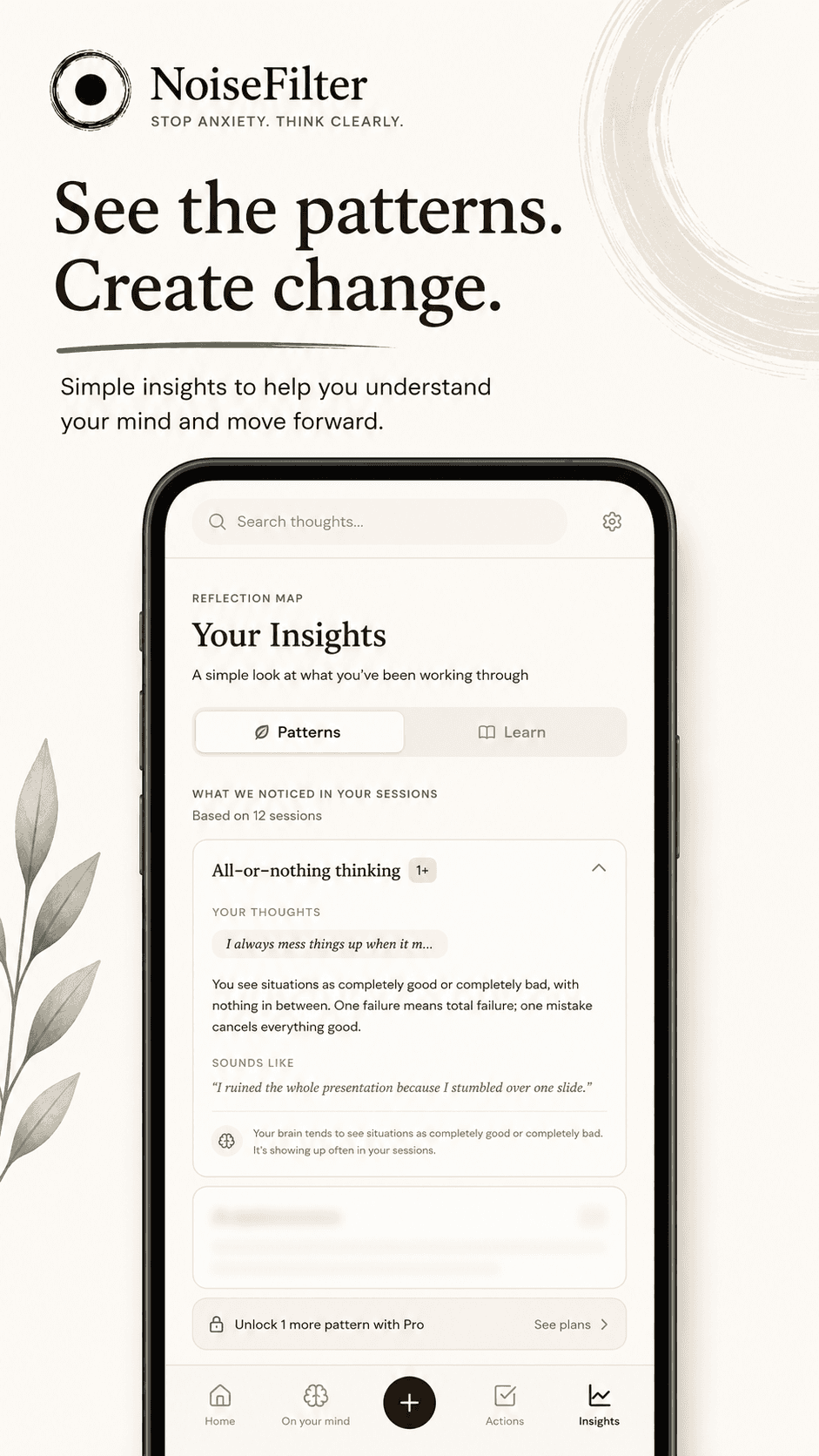
Every thought you log has a status — active, working on it, resolved, settled. Over weeks you start to see patterns. What kinds of thoughts recur. What tends to resolve them. What you've already worked through that you don't need to carry anymore.
That's different from a chatbot that forgets every conversation. Different from a journal that stores thoughts without processing them. Different from a mood tracker that measures how you feel without doing anything about it.
| Noisefilter | Journaling | Chatbot apps | Mood trackers | |
|---|---|---|---|---|
| Processes the thought | ✓ | ✗ | ✗ | ✗ |
| Thoughts persist | ✓ | ✓ | ✗ | ✗ |
| Evidence-based framework | ✓ | ✗ | ✗ | ✗ |
| Pattern detection | ✓ | ✗ | ✗ | partial |
| Works at 2am | ✓ | ✓ | ✓ | ✓ |
| Free to start | ✓ | ✓ | partial | partial |
What people are working through
Built by someone who spent 11 weeks on a therapy waitlist. This is that tool.
“I processed a thought I'd been carrying for 8 months. One session.”
“I kept journaling the same things over and over. This actually moved them.”
“My therapist assigns CBT homework between sessions. This is basically that — but I can do it at midnight when the thought hits.”
Free to start. Upgrade only if you need more.
Billed through Google Play. Cancel anytime. Your data is never deleted if you downgrade.
The thought has been there long enough.
Work through it tonight. Free to start, no waitlist, no therapist needed.
Android 8.0+ required. Free account needed to save sessions.
On iPhone? Join the iOS waitlist →